
What Is Range of Motion?
Range of Motion is the movement available at a joint or across a body region. It describes how far a joint can bend, straighten, rotate, or move in another direction. Clinicians assess active movement performed by you and passive movement guided by another person to understand mobility and movement limits.
Quick Facts About Range of Motion
Category
Movement assessment
Used for
Tracking joint mobility
Common confusion
Mobility is not the same as strength
Also called
ROM, Joint mobility
Often discussed with
Corrective Exercise Therapy, Sports Injury Treatment
Key Takeaways About Range of Motion
- Range of Motion describes movement in a specific direction.
- Active and passive movement provide different information.
- Range of Motion is not the same as muscle strength.
How Range of Motion Works
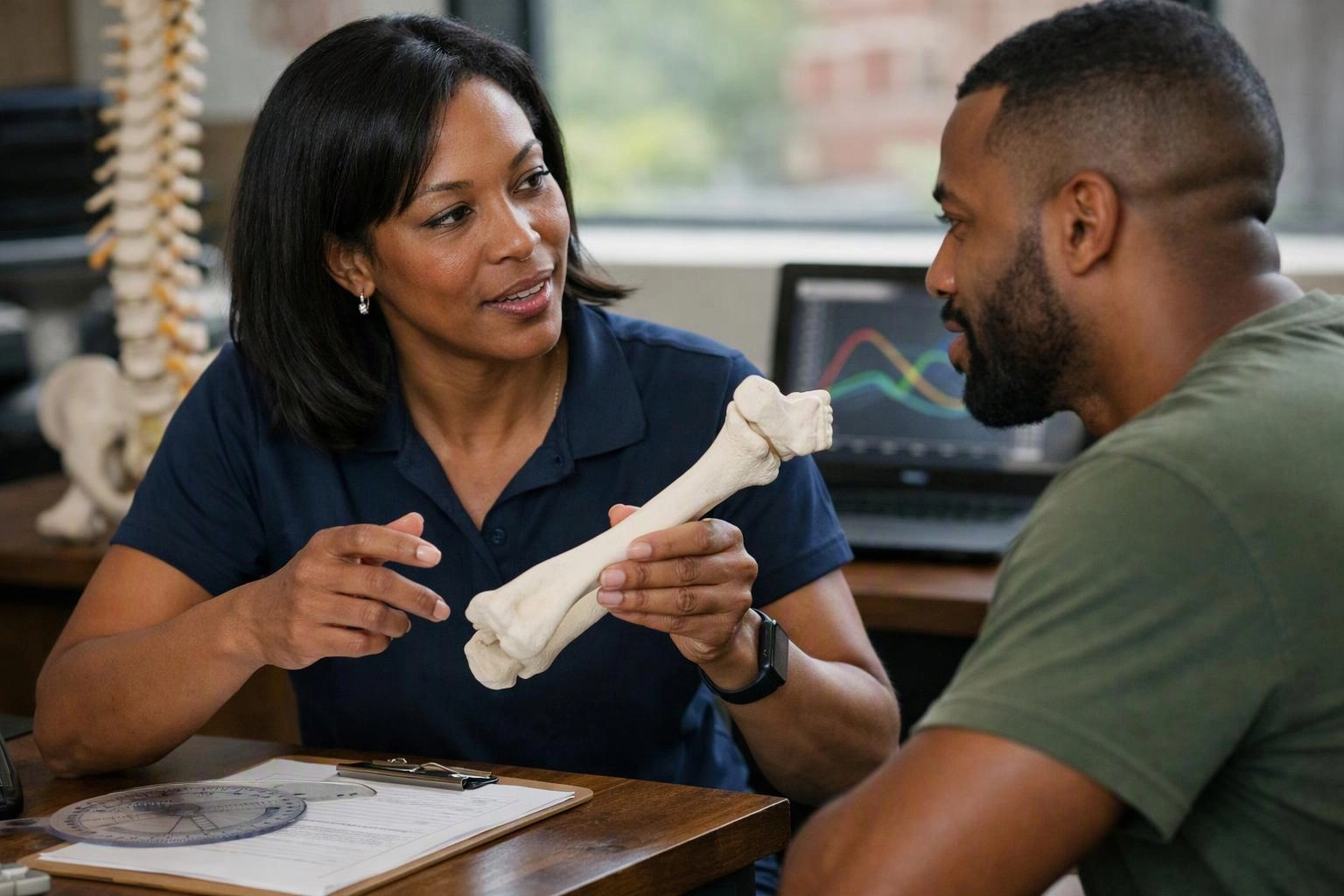
Range of Motion describes movement at a joint or across a body region. A person may move actively by controlling the motion, or a practitioner may guide the movement passively. These two observations can reveal different limits because pain, stiffness, muscle control, and joint structure may affect movement in different ways.
Related glossary terms: Joint Mobilization, Gait Analysis, Proprioception.
Assessment focuses on the direction and quality of movement, not only its distance. A practitioner may observe how the body bends, straightens, rotates, or reaches. In Corrective Exercise Therapy, these observations help shape exercises that practice controlled movement. For example, an exercise may ask you to move through a comfortable portion of shoulder motion while maintaining steady posture.

From the Arrowhead Clinic Chiropractor Atlanta team
When we assess Range of Motion, we observe how a person moves and note control, stiffness, and compensation. We connect those findings with the goals of Corrective Exercise Therapy. Our team then selects movement drills that match the observed pattern and can be performed with steady control.
Range of Motion in Practice: A Real-World Example
A person with limited shoulder movement may struggle to reach an overhead shelf. During Corrective Exercise Therapy, the practitioner may guide controlled shoulder movements and then assign exercises that reinforce smoother active motion.
Related Terms
Joint Mobilization
Joint Mobilization is a hands-on technique that applies controlled, repeated movement to a joint and its…
Gait Analysis
A gait analysis is a structured assessment of how you walk or run. The assessment examines…
Proprioception
Proprioception is the body's ability to sense the position, movement, and force of its joints and…
Rotator Cuff
A Rotator Cuff is a group of muscles and tendons that stabilizes the shoulder joint and…
Arrowhead Clinic Chiropractor Atlanta
Have Questions About Range of Motion?
Contact Arrowhead Clinic Chiropractor Atlanta for practical guidance on Range of Motion and related chiropractor work in Atlanta.